January 20, 1993
Dear Colleague,
In this first newsletter of 1993, I would like to make my yearly appeal for honest and accurate reporting. The success of our collaborative effort depends very much on the quality of the data that you provide. Especially new workers who have not been associated with the international study during previous years should be reminded that our study's emphasis is on data accuracy and on truthful reporting of failures. We do not release statistics of individual centers and it therefore would make no sense at all to withhold information on failures. To the contrary, great harm would be done because the results of the CTS analyses would be falsified. I therefore would like to repeat my appeal that those who cannot fully subscribe to this philosophy should drop out rather than spoil the sincere efforts of all other participants. Similarly, we in Heidelberg are committed to reporting the results of the CTS analyses "unpolished", just as they are, regardless of whether they fit our hypotheses or not.
This is a very good time for checking whether the number of transplants listed for 1992 in the "Summary Section" of your printout corresponds to the number actually performed. If not, please report any missing cases as soon as possible. It is extremely important that all consecutive transplants be included in the collaborative study. Thank you for your understanding.
_______________
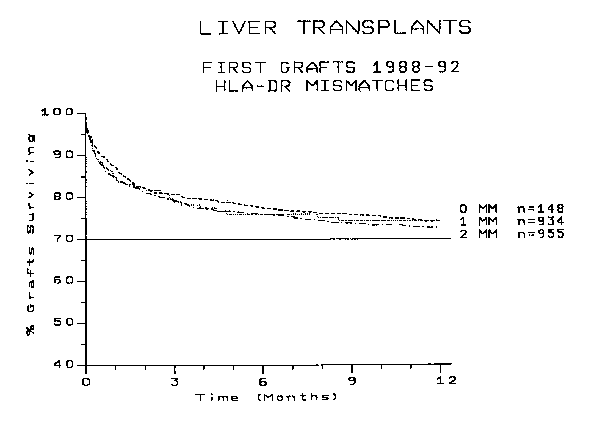
As for the scientific part of this newsletter, we would like to address a controversial topic: the influence of HLA compatibility in liver transplantation. Compared to the kidney and heart transplants, our data base for liver grafts is relatively small. Moreover, only about one-half of the transplants reported were HLA typed. Nevertheless, the CTS data is the largest existing source for analyzing the effect of HLA mismatches on graft outcome. Unfortunately, the transplant numbers are too small to obtain conclusive answers. In previous newsletters we have shown that there was no significant effect of HLA compatibility on liver graft outcome. This continues to be true when all available transplants are considered. The results for the influence of HLA-DR are shown in Figure 1. For the purpose of this report, we will disregard the HLA-A and -B antigens because the patient numbers are too small for a comprehensive analysis.
Figure 1
Interestingly, there are remarkable differences in the effect of HLA mismatches depending on the patients' original disease. Examples are provided in Figures 2-5. Whereas one can see trends of an improved survival with better matches in patients with autoimmune cirrhosis or alcoholic cirrhosis, the opposite effect is evident in patients with primary biliary cirrhosis or sclerosing cholangitis.
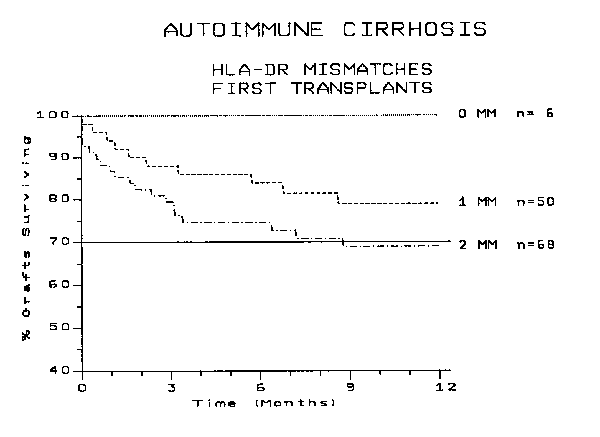
Figure 2
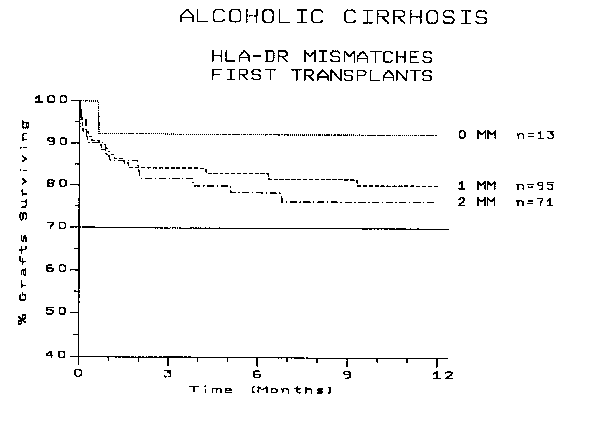
Figure 3
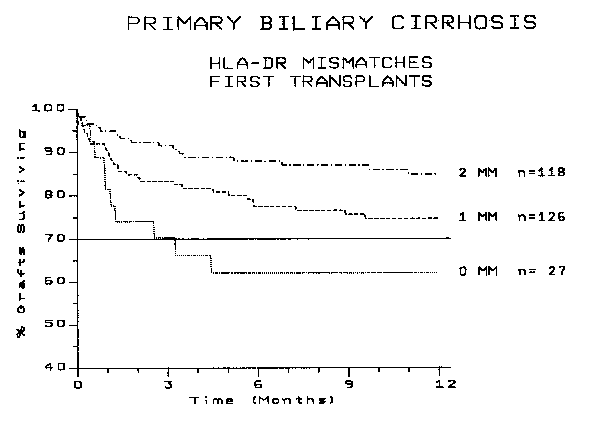
Figure 4
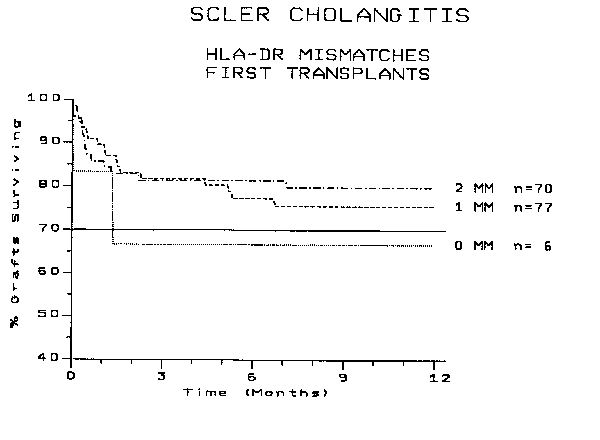
Figure 5
The main problem with these analyses is that the numbers of well matched grafts are very small. It is therefore not possible to tell whether the effects illustrated in the figures are true effects or statistical quirks. Nevertheless, we find the trends exceedingly interesting. For example, we did not obtain similar diverging results in a parallel analysis of heart transplants. It is conceivable that the overall lack of influence of HLA in liver transplantation may be composed of counteracting influences in subsets of the data. At this stage it would be futile to speculate about the underlying mechanisms. The first order of priority must be to follow up on this interesting preliminary result, to prove or disprove it. For that purpose, it will be necessary to accumulate additional data. With two or three times the numbers of transplants, we will be able to produce statistically solid results. Only if the current trends can be substantiated will it be meaningful to address the obvious host of resulting questions.
I would like to thank all liver transplant centers for their support, especially for providing HLA typing information, and I would like to encourage everyone to continue. If you know of centers that are not participating but might have an interest to join, please let me know so that I may invite them.
With my very best wishes for the New Year to all CTS participants, I remain,
Sincerely yours,