February 20, 1997
This year started off positively with a record number of new transplant registrations. On the other hand, a few centers have fallen behind with their reporting to such an extent that we had no choice but to inactivate them from the study. It has been our longstanding policy to inactivate centers that have failed to communicate for extended periods of time. The reason, of course, is that it is very important to keep the CTS database current because otherwise we would possibly reach conclusions based on historical data that are not relevant anymore. Centers that have been excluded can reenter the study by submitting a recent update. Judging from past experience, it is much better to remain abreast by providing regular updates than to accumulate a back log that usually proves very cumbersome to deal with.
Now is an excellent time for checking whether all transplants performed at your center during the last year have been reported and registered. The chronological sort of your printout makes it easy to ascertain the completeness of your records. In addition, the summary table (data status) provided at the end of the update section lists both the numbers of transplants for each year and the last transplant registered. Please be sure to report any missing transplants within the next few weeks.
For new staff members at participating centers I would like to point out that the Collaborative Transplant Study has strictly scientific objectives. We would like to learn from past experience, with the hope to make a small contribution towards the improvement of future transplant results. For that reason, it is extremely important that all data be reported accurately and honestly. Please do not withhold information on failures. The resulting distortion of statistical computations would be terribly unfair to all others who have submitted truthful reports. There is nothing to be gained from such a strategy since the success rates of individual centers are not released to anyone. In the interest of scientific fairness, I would like to repeat my annual appeal that those who cannot subscribe to the basic principle of truthful reporting should withdraw from the study.
I hasten to add that I have no reason to believe that we have a problem with dishonest reporting and that the quality of data reported to the CTS continues to be outstanding. All those involved in the collection and submission of data deserve to be given credit for their extraordinary spirit of cooperation in the interest of gaining scientific knowledge for the benefit of transplant patients.
An update on the status of the DNA project shows that nearly 3000 frozen cell samples were submitted for testing during the last shipping cycle. The next date for sending material to Heidelberg is
June 24/25, 1997
Please be sure to send us a fax with the shipping details (AWB number and flight number). Do not forget to indicate that the parcel contains "frozen blood cells of transplant recipients and donors, for in-vitro testing only, non-infectious, for use within an international scientific project, no commercial value".
Should you just have begun collecting material: cells for DNA typing can be obtained in the following ways:
1) Obtain 20 ml of EDTA blood from the recipient or
donor, centrifuge briefly and transfer the buffy coat to a small
tube, preferably with a screwcap. Label clearly. Simply freeze in
a
-20C freezer until shipment.
2) Alternatively, you may obtain a piece of spleen (walnut size) or a couple of lymphnodes from the donor and freeze in a screwcap tube without any preservation solution.
Presently, we are especially interested in obtaining cells of heart transplant recipients and donors. If you have material available on more than 10 recipient/donor pairs, please contact me or Dr. Scherer at fax Germany (6221) 564200 in order to make shipping arrangements.
I can gladly report that the Steroid Withdrawal Study is making good progress. Patients maintained on a steroid-free protocol (both in the randomized and in the non-randomized study arm) continue to enjoy an excellent outcome. Thus, it appears that the perceived risk of withdrawing steroids cannot be very great. I would therefore like to encourage you to register patients who meet the inclusion criteria. Registration forms are attached to this newsletter. Should you have questions, please do not hesitate to contact me.
We received nearly 6000 patient sera for the anti-IgG project from the following centers:
Barcelona, Berlin, Brussels, Budapest, Cardiff, Dallas, Essen, Freiburg, Geneva, Glasgow, Heidelberg, Helsinki, Lausanne, Lexington, Liege, Ljubljana, Medellin, Munich, New York, Phoenix, Prague, Quebec, Reims, Rijeka, Rio de Janeiro, Seoul, Strasbourg, Sydney and Zagreb. We thank all contributors for their generous support. It will take a few months to complete the testing and we will furnish you with results in a later issue of the newsletter.
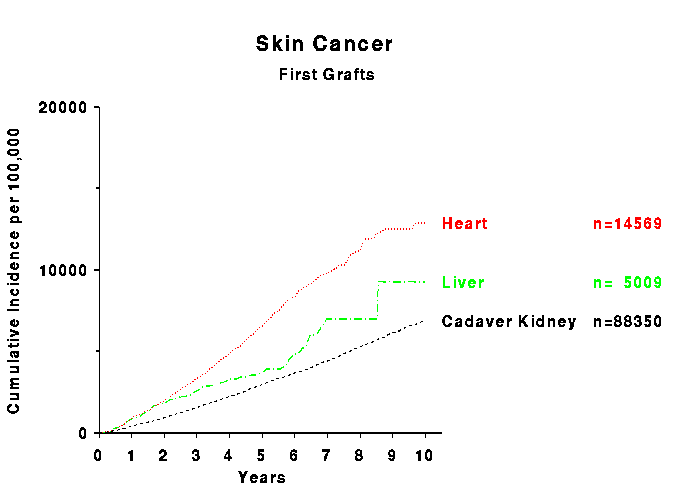
The 10-year cumulative rates of skin cancer in kidney, heart and liver transplant recipients are illustrated in Figure 1.
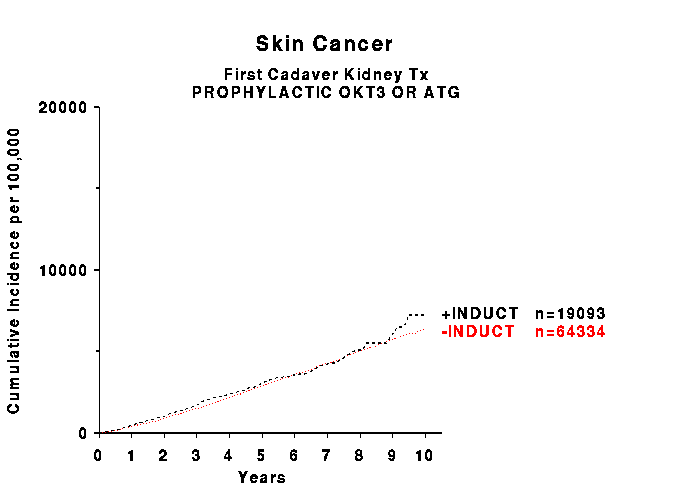
Irrespective of the type of organ transplanted, approximately one-half of the skin cancers were reported to be basal cell cancers and the other half were squamous cell cancers. Note that the cancer rate in heart transplant recipients is nearly twice as high compared with the rate in kidney patients. This result is reminiscent of previous analyses of posttransplant lymphomas which also showed a significantly higher rate in heart than in kidney recipients. However, whereas there was evidence that a higher lymphoma rate is related to induction treatment with antilymphocyte antibodies, no such evidence was found for skin cancer. As shown in Figure 2, whether patients received induction treatment with prophylactic monoclonal (OKT3) or polyclonal (ATG) antibodies or not, the incidence of skin cancer was identical.
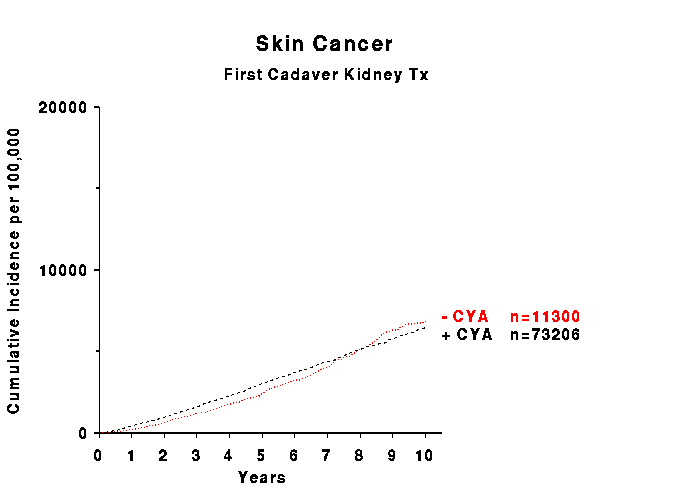
There was no difference in the rate of skin cancer when patients with or without immunosuppressive treatment with cyclosporine were compared (Figure 3).
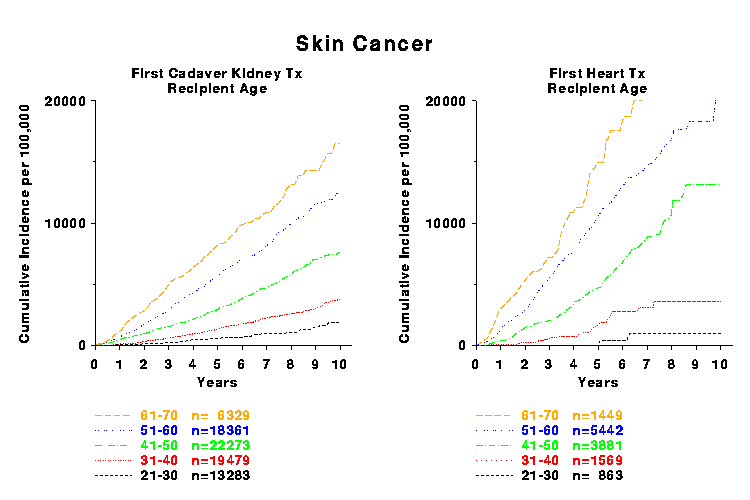
Not unexpectedly, there was a very strong age effect both in kidney recipients and in heart recipients. Especially in the age categories from 40 years upward, the cancer incidence in heart transplant recipients was strikingly higher than that in kidney recipients (Figure 4).
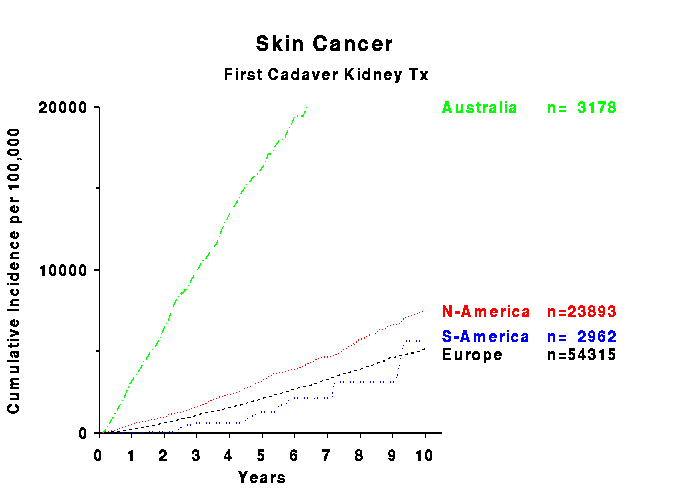
It is well known from reports of the Australian transplant registry that the incidence of skin cancer in Australia exceeds that elsewhere. As shown in Figure 5, based on the CTS data, the increased skin cancer rate in Australia is impressive.
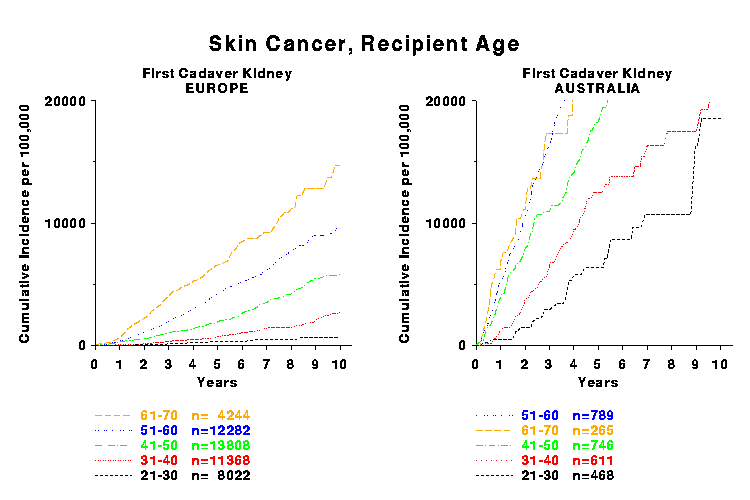
Equally impressive is a comparison of European and Australian skin cancer rates for different subgroups of recipient age. In every age category, the skin cancer rate in Australia is strikingly higher than that in Europe (Figure 6). Whether a greater exposure to sunlight can serve as the sole explanation for this effect deserves further study.
These preliminary results demonstrate that the CTS database is a very powerful instrument for comparative analyses of cancer rates in transplant patients. We have restricted the analysis to centers that confirmed the completeness and accuracy of cancer records on the cancer questionnaire. Thanks to your support and cooperation, more than 100.000 patients can now be included in the malignancy analysis. As we move on to investigate further details as well as additional tumors, we will inform you periodically on the progress of this work.
A few study participants have still not returned the cancer questionnaire. Especially in a field such as the analysis of posttransplant malignancies, the cooperation of many transplant centers is essential for obtaining a sufficiently large database. If you have not yet done so, please make your data available for this important study. It is not too late for having your results included.
Thank you very much for your continued cooperation.
Sincerely yours,