CTS Collaborative Transplant Study
Dear Colleague
In Newsletter 1:2018, an analysis of the influence of pre-transplant dialysis on the survival of kidney grafts was presented. Almost 200 thousand adult recipients of first deceased donor kidney transplants were studied. It was shown that the influence of the pre-transplant dialysis time increased over time and that pre-transplant dialysis time had a strong effect on transplants from expanded criteria donors. As in many other studies, retransplants were excluded from analysis. In retransplants, in addition to the known factors influencing graft survival, there is an additional important predictor, the duration of the preceding graft. The importance of this confounder was already pointed out in CTS Newsletter 5:1986, more than 35 years ago. In the current newsletter, we would like to explore whether this influence has also changed over the years.
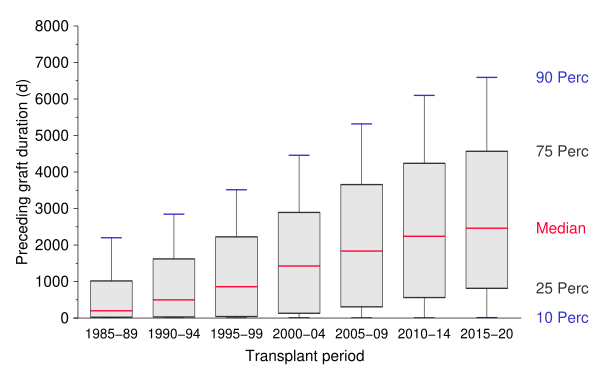
The 5-year death-censored graft survival of 35,292 deceased donor kidney retransplants performed from 1985–2019 in adult recipients (18–64 years) was analyzed. 64 years was chosen as the upper age limit of recipients in order to exclude any possible influence on the results by special donor kidney allocation models. 84% of the retransplants were second transplants, 14% third and 2% fourth to seventh transplants. The proportion of retransplants has not changed significantly over the years. While it was 15.7% in the 1980s, it was 15.1% in the last five years. But the mean duration of the preceding graft has steadily increased due to advances in transplantation medicine. The median has increased from 199 days in the 1980s to 1,425 days (3.9 years) at the beginning of this millennium, and further to 2,461 days (6.7 years) in recent years (Figure 1).
In order to illustrate changes with time of the influence of preceding graft duration on retransplants, the entire transplantation period was divided into three equal 12-year intervals.
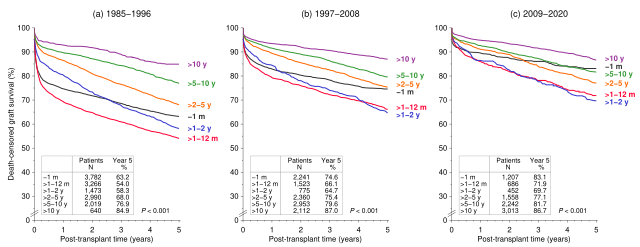
In Figure 2, the disadvantage of a short graft duration of up to two years is clearly evident. The difference between >1–12 m and >1–2 y, which was evident in the first period 1985–1996, disappeared during the following periods. A particularly strong improvement over time is evident if the preceding graft duration was less than one month. The hazard ratio (HR) of the multivariable Cox regression, with >10 y as reference, changed from 2.7 (95% confidence interval (CI) 2.2–3.3, P<0.001) in the first period 1985–1996 to 2.1 (95% CI 1.8–2.4, P<0.001) in 1997–2008 and only 1.5 (95% CI 1.2–1.8, P <0.001) in the last period from transplantation year 2009. In other words, whereas the group with first graft failure within one month was a high-risk group for retransplantation in the 1985–1996 period, these patients were a low risk for retransplantation during 2009–2020.
In the multivariable Cox regression, the following confounders were considered: transplant year, graft number, geographical region, recipient and donor race, age and sex, recipient treatment for diabetes, recipient history of smoking, end-stage renal disease, panel reactive antibodies (PRA), general evaluation of the recipient eligible for transplantation (including cardiovascular risk), recipient and donor cytomegalovirus (CMV) status, CMV prophylaxis, cause of donor death, donor history of hypertension, marginal donor (e.g. cancer), donor death after cardiac death, number of HLA-A+B+DR mismatches, cold ischemia time, induction therapy, type of antimetabolite, steroid-free regimen, and type of calcineurin inhibitor. It is noteworthy that, according to Wald's z-value, the preceding graft duration has the strongest influence on 5-year death-censored graft survival of all considered confounders, even stronger than the donor age.
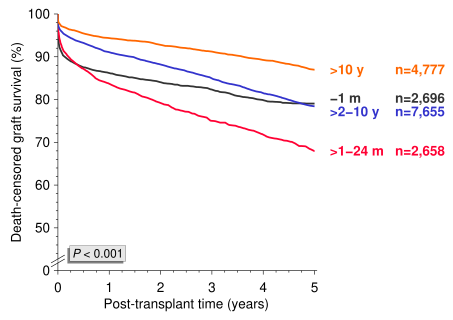
For separate analysis of the 17,786 retransplants performed since the year 2000, only the following four categories of preceding graft duration were considered due to the smaller number of cases: up to one month (–1 m), more than one month up to two years (>1–24 m), more than two years up to ten years (>2–10 y), and more than ten years (>10 y). The corresponding Kaplan-Meier analysis in Figure 3 once again impressively shows the large differences with regard to the preceding graft duration, which leads to a remarkable hazard ratio of 2.4 in the Cox regression for the comparison >1–24 m vs. >10 y.
In the corresponding Cox regression to Figure 3, when checking whether there were interactions between duration of the preceding graft and the other confounders, a significant dependency was found for pretransplant panel-reactive antibodies (PRA). To illustrate this, Figure 4 shows the Kaplan-Meier analysis of the influence of the preceding graft duration for three PRA categories.
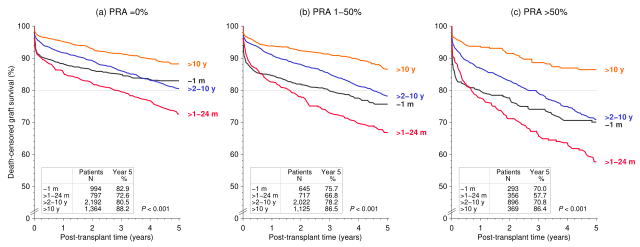
An increase in the effect of previous graft duration with increasing levels of antibodies was found (Figure 4). The results of the corresponding multivariable Cox regression confirm this result (Table 1).
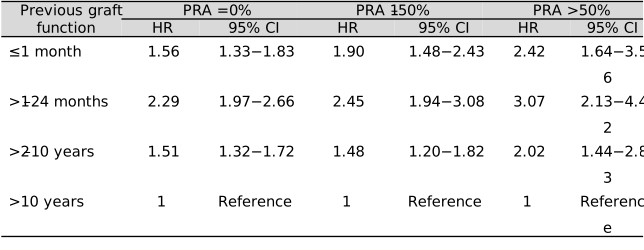
The interaction between antibodies and the duration of the preceding graft becomes perfectly clear when the influence of antibodies is considered for the two groups of previous graft duration >1–24 months and >10 years (Figure 5).
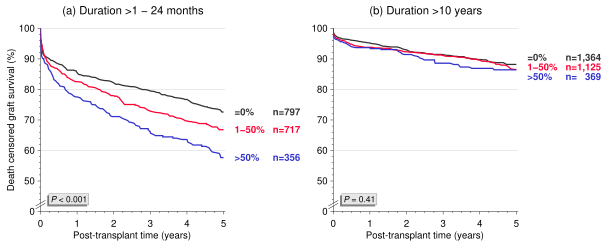
In summary, these analyses show (i) that a short duration of the preceding graft is a strong predictor of risk of graft failure in retransplants and (ii) the influence of pretransplant antibodies on retransplants decreases with a longer duration of the preceding graft.
The next shipping date of DNA and Serum Studies is
July 15, 2022.
Remain safe and healthy!
Yours,
Hien Tran
| And your CTS Team in Heidelberg: | |||
| Christian Unterrainer | Andrea Ruhenstroth | Sofia Cinca | Bernd Döhler |
| Gesine Mehlich | Michael Döntgen | Kezban Ozansoy | Cornelia Mohr |