CTS Collaborative Transplant Study
Dear Colleagues,
Developments in the field of transplantation medicine, such as the increasing use of marginal donors, require adjustment of the questionnaires of the CTS study. This is not always easy, as it has to be done in accordance with a dataset that has been built up over forty years. The last major revision of the general CTS forms took place in September 2018. The changes concerned organ preservation, donor risk index, calculated/virtual panel reactive antibodies, graft function during first 24 hours, and the classification and treatment of rejections. It is not uncommon that it takes many years of data collection before newly introduced variables can be evaluated. An exception which can be presented in for this current newsletter is the variable "graft function during first 24 hours", because retrospective data could be utilized to a large extent.
Delayed graft function (DGF) has been an intensely debated topic since the 1980s to this day. There is wide variability in the definition of DGF. Yarlagadda et al., in a 2008 review paper (Nephrol Dial Transplant, doi: 10.1093/ndt/gfn158), listed 18 different definitions of DGF, classified by dialysis- or creatinine-based definitions and their combinations. Results on immediate graft function during the first 24 hours were reported by Süsal as part of the Pre-Transplant Serum Study (see CTS Newsletter 3:2018). In the present newsletter, we would like to present data regarding the relevance of graft function during the first 24 hours (GF24) on subsequent long-term survival in transplants that were all functioning 6 months later.
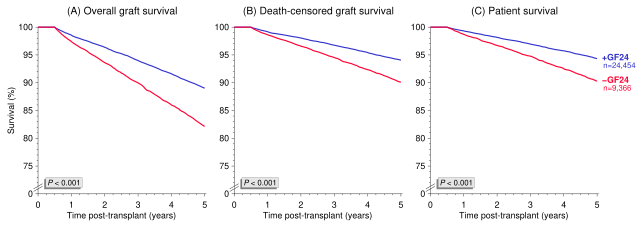
The 5-year overall graft, death-censored graft and patient survival rates of 33,820 deceased donor kidney transplants performed from 2000–2019, for whom information on graft function during the first 24 hours and at 6 months post-transplant was available, were analyzed (Figure 1). Multiorgan and combined kidney-pancreas transplants were excluded. 9.7% of the transplants in this analysis were retransplantations, 3.3% of the patients were children under 18 years, and 13.4% were elderly patients ≥65 years of age. The proportion of grafts without function during the first 24 hours and with subsequent function at 6 months post-transplant in this analysis is 27.7% and has not changed significantly over the years.
Significantly better 5-year survival rates were observed in transplants (which all were functioning at 6 months, the starting point of this survival analysis) that were functioning within the first 24 hours than for those which commenced to function later than 24 hours after transplant surgery. It is noteworthy that in all three Kaplan-Meier analyses shown in Figure 1, approximately the same difference in risk is observed between grafts with or without function during the first 24 hours: all cause graft failure: hazard ratio (HR) 1.70 (95% confidence interval (CI) 1.59–1.82), death-censored graft failure: HR=1.71 (95% CI 1.55–1.87), patient mortality: HR=1.76 (95% CI 1.61–1.94). We expect from experience that this analysis must have been influenced by other variables. As an example, Figure 2 illustrates the influence of the two most important confounders in this analysis, namely donor age and cold ischemia time. The fraction of transplants without function during the first 24 hours increased with increasing donor age and prolonged ischemia.
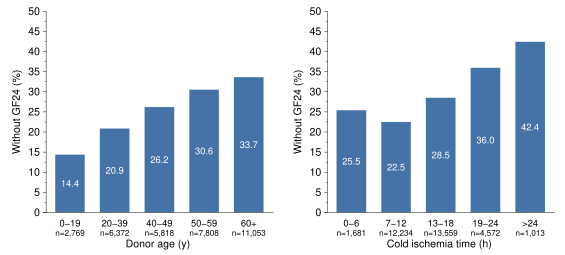
We analyzed whether there are subpopulations in which GF24 might have a particularly adverse effect on follow-up, such as old donors, transplants with prolonged cold ischemia time, retransplantations, or sensitized patients.
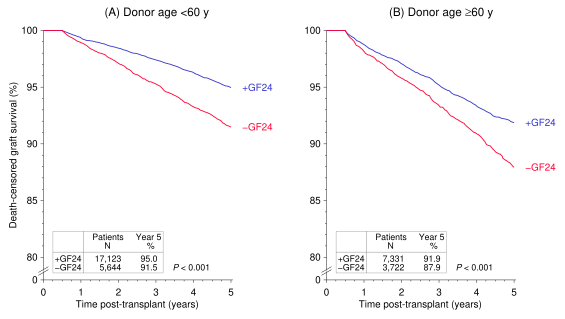
In Figure 3, the study population was stratified with respect to donor age into the two groups, <60 years and ≥60 years, according to the expanded criteria donor definition. While about a quarter of patients (24.8%) with a donor age below 60 years had no graft function during first 24 hours, the proportion increased to about a third (33.7%) with grafts from ≥60 years-old donors. Looking at death-censored graft survival to 5 years in these two donor age groups, Figure 3 shows that the impact of GF24 in terms of absolute difference in death-censored graft survival is similar in both groups (3.5 vs. 4.0 percentage points). The increased failure risk for –GF24 was even slightly smaller for kidneys from older (HR=1.5) than for kidneys from younger donors (HR=1.7).
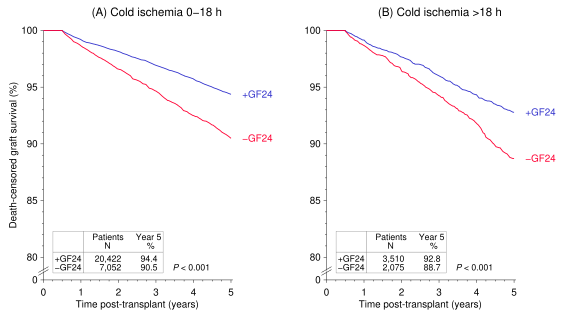
With respect to cold ischemia time, Figure 2 as well as previous analyses (e.g. CTS Newsletter 1:2010) show that 18 hours is a good cut-off for the subdivision into two subpopulations with different death-censored graft survival. In the current analysis, there is an increase in the proportion of transplants without graft function during the first 24 hours from about a quarter (25.7%) with ischemia up to 18 hours to more than a third (37.2%) with ischemia time above 18 hours. Figure 4 shows that cold ischemia time has no effect with respect to the impact of GF24 on long-term death-censored graft survival. Whereas the effect of graft function during the first 24 hours was significant in both subgroups (each P<0.001), both the absolute differences after 5 years (3.9 versus 4.1 percentage points) and the hazard ratios for death-censored graft failure (1.7 versus 1.6) were virtually identical.
When first transplants were compared with retransplants or patients without panel reactive antibodies (PRA=0%) were compared with patients with antibodies (PRA>0%), similar results were obtained. With these two stratifications, the influence of graft function during the first 24 hours on 5-year death-censored graft survival did not differ significantly (data not shown).
To summarize, it is surprising that in groups of patients with an increased risk of graft failure such as transplants with donor age ≥60 years (Figure 3), prolonged ischemia time greater than 18 hours (Figure 4), retransplantations or recipients with preformed antibodies, the influence of no graft function during the first 24 hours on long term graft survival after 6 months is not stronger than in the corresponding more favorable
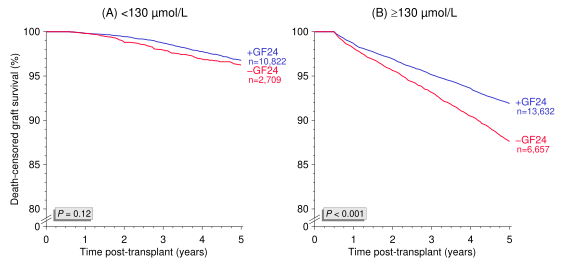
The situation is very different when serum creatinine 6 months after transplantation is considered, which is recorded categorically in the basic follow-up of CTS, so that only 130 µmol/L can be used as a cut-off for analysis. Of the recipients with a functioning graft during the first 24 hours and after six months, 44% achieved a serum creatinine value below 130 µmol/L after six months. By contrast, only 28% of the patients without graft function during the first 24 hours but with a functioning graft at 6 months achieved this good 6-month creatine value of <130 µmol/L. Figure 5 shows that among transplants with a good 6-month serum creatinine level below 130 µmol/L, the influence of GF24 on the 5-year death-censored graft survival rate no longer reaches significance (HR=1.22, P=0.12). Among transplants with a creatinine level ≥130 µmol/L, however, the impact of GF24 was significant and strong (HR=1.54, P<0.001).
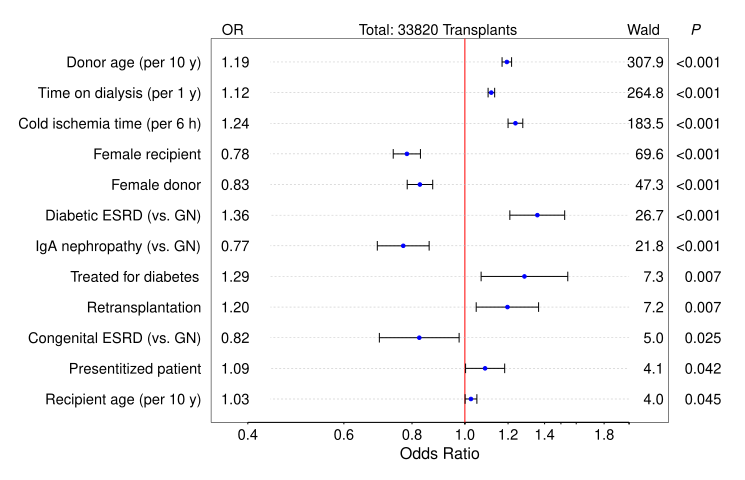
The previously shown Figure 2 suggests that both donor age ≥60 years and ischemia time over 18 hours are significantly associated with lack of function during the first 24 hours. In 2010, Irish et al. developed a prediction model for delayed graft function (Am J Transplant, doi: 10.1111/j.1600-6143.2010.03179.x) in which donor creatinine, body mass index and donation after cardiac death were mentioned as significant predictors in addition to donor age and cold ischemia time. A limitation of the CTS study is that body mass index at the time of transplantation and donor creatinine are not available. We performed a logistic regression with the following variables that were available to us: transplant year, graft number, geographical region, recipient and donor race, age and sex, recipient treatment for diabetes, end-stage renal disease (ESRD), panel reactive antibodies, general evaluation of the recipient eligible for transplantation, recipient and donor cytomegalovirus (CMV) status, CMV prophylaxis, cause of donor death, donor history of hypertension, marginal donor, donor death after cardiac death, number of HLA-A+B+DR mismatches, and cold ischemia time.
Figure 6 illustrates the differential influence of significant predictors in the logistic regression model. The analysis shows that donor age, time on pre-transplant dialysis and cold ischemia time are by far the strongest predictors of no graft function during the first 24 hours.
The next shipping date of DNA and Serum Studies is
October 14, 2022.
Remain safe and healthy!
Yours,
Hien Tran
| And your CTS Team in Heidelberg: | |||
| Christian Unterrainer | Andrea Ruhenstroth | Sofia Cinca | Bernd Döhler |
| Gesine Mehlich | Michael Döntgen | Kezban Ozansoy | Cornelia Mohr |