CTS Collaborative Transplant Study
Dear Colleague
Since 1997, post-transplant serum cholesterol has been recorded in four steps in the CTS database. A first evaluation was made about 20 years ago in Newsletter 2:2003. In 2004, the questionnaire was expanded to include high-density lipoprotein (HDL) and low-density lipoprotein (LDL) in addition to the value of total serum cholesterol. In this newsletter, we would like to present an analysis of the impact of one-year post-transplant HDL and LDL cholesterol on graft outcomes in kidney transplant patients.
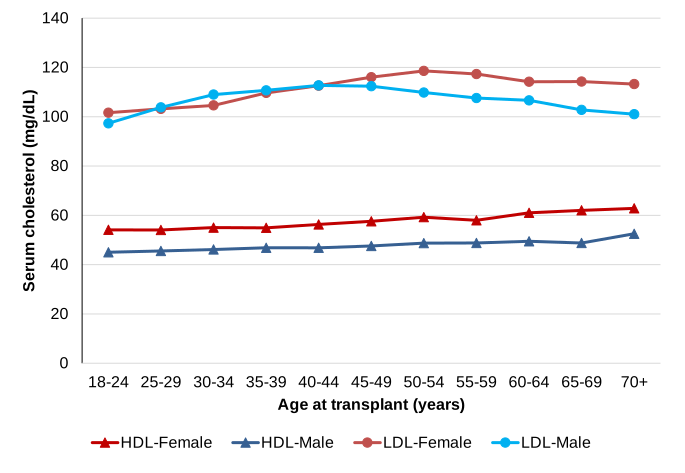
26,433 adult patients (≥18 years) who received kidney-only transplants from 2003 to 2020, with a functioning graft one year after transplantation, and for whom HDL and LDL levels were available one year after transplantation, were analyzed. 9.3% of the transplants were retransplants and 30.1% were from living donors. Apart from genetic predisposition and diet, both of which were unknown to us, it is known that recipient gender and age, or the use of lipid-lowering statins have an influence on serum cholesterol levels. Figure 1 illustrates the influence of sex and age on 1-year HDL and LDL in kidney transplant patients.
Figure 1 shows that transplanted women have an average of 10 mg/dl higher HDL values than men, whereas a similar difference in LDL is only found in recipients aged ≥50 years. Except for the LDL values for patients ≥50 years, a slight increase in cholesterol values with increasing age can be observed. The drop in LDL levels in those aged ≥50 years could be a consequence of the increasing use of statins with age. While only about 14% of patients aged 18 to 24 years received statins, statins were administered to more than 50% of patients aged ≥65 years.
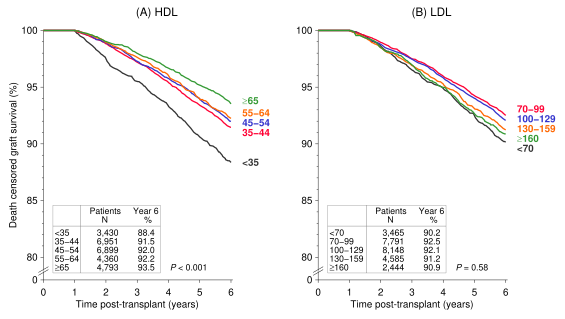
Although publications on a significant influence of serum cholesterol on graft function can be dated back to the 1970s, conflicting findings were reported and the topic has remained controversial. Our Kaplan-Meier analysis of the large CTS cohort with long-term observation clearly shows that low HDL levels lead to significantly worse death-censored graft survival (Figure 2A). Patients with an HDL of less than 35 mg/dl have a more than 50% increased risk of graft failure compared with those with an HDL of 45 – 54 mg/dl (hazard ratio [HR] 1.53, 95% confidence interval [CI] 1.32 – 1.77). For LDL, there is no significant linear trend for serum levels and graft survival (Figure 2B).
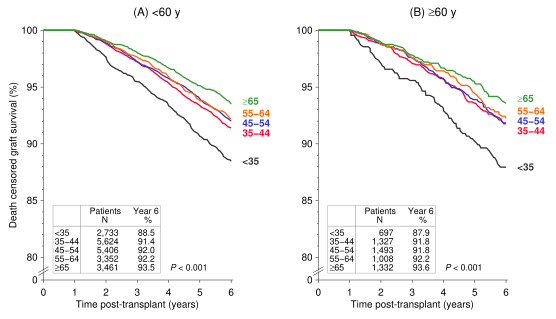
Figure 3 shows that the impressive negative impact of low HDL levels below 35 mg/dl on death-censored graft survival is independent of whether patients were younger or older than 60 years at time of transplantation. In both younger recipients (under 60 years) and older patients (60 years and older), the risk of graft failure significantly increases by more than half with an HDL level of <35 mg/dl. Stratifications with respect to other important confounders for death-censored graft survival, such as transplant number (first transplants, retransplants), donor relationship (living donor, deceased donor), donor risk (standard donor, expanded donor), transplant year, or medication with statins also show similar risks for HDL levels of <35 mg/dl (not shown). However, as Figure 4 demonstrates, there are differences between female and male recipients.
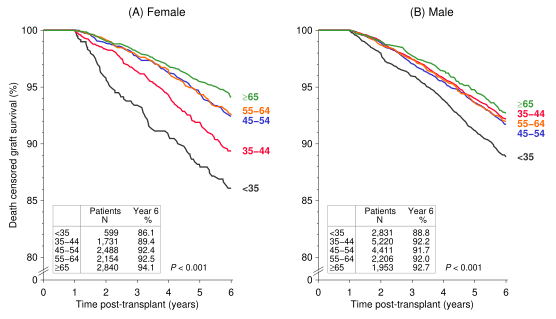
As already shown in Figure 1, women have on average about 10 mg/dl higher HDL values than men. A proportion of 17.0% of male patients have an unfavorable HDL value of less than 35 mg/dl compared to only 6.1% of women. Figure 4 shows that significantly poorer death-censored graft survival can be observed in female recipients already at HDL values of below 45 mg/dl. That means that a higher 1-year cut-off of 45 mg/dl can be used for risk assessment in transplanted women. This affects almost a quarter (23.7%) of female recipients.
Cholesterol values are collected in CTS for the first time one year after transplantation for patients with a functioning graft, and thereafter at 2, 3, 5, 10, 15, and 20 years after transplantation. Analyses of HDL levels 1, 2, 3, and 5 years after transplantation of patients on whom HDL values are known at all four time points have shown that the levels are almost constant. For male patients, the mean values vary minimally between 47.1 and 47.2 mg/dl, and for female patients between 55.8 and 56.4 mg/dl (the differences are not significant). There were some reports in the literature on an association of HDL levels with increased risk of acute graft rejection. Using the large dataset of CTS, we aimed to verify these observations. Unfortunately, because pretransplant serum cholesterol levels are not available in the CTS registry, it is not possible to analyze the impact of pretransplant HDL levels on the incidence of rejection in the first year after transplantation. However, the CTS data allow to analyze the impact of HDL levels on the particularly critical late rejections after the first post-transplant year, by considering only those patients who had no rejection treatment in the first year after transplantation. Figure 5 shows that HDL levels have a prospective impact on the de novo incidence of rejection after the first post-transplant year. The results are similar to those of death-censored graft survival. .
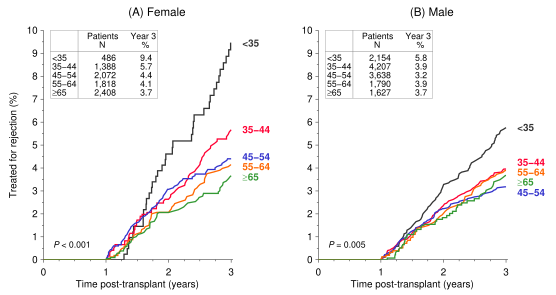
In summary, these analyses show that low 1-year post-transplant HDL serum cholesterol of <35 mg/dl for men and <45 mg/dl for women is a strong predictor of subsequent risk of graft failure or rejection in kidney transplantation.
The next shipping date of Serum and DNA
for the Biomarker Studies is
April 14, 2023.
Many thanks to all centers that submitted the Covid-19 Information Form over the last two years. We completed the data collection phase and have been working on the analysis. A preliminary result was presented at the TTS Meeting in September 2022 in Buenos Aires.
The CTS is now in its 41st year. We are grateful to all of you who, with your regular contribution of transplant and follow-up data, make it possible to generate these global surveys and reports for our scientific community.
for your continued support and best wishes,
Hien Tran
for your CTS Team in Heidelberg