CTS Collaborative Transplant Study
Dear Colleagues,
In our recent Newsletter 4:2024, we focused on the association of steroid use with the incidence of newly diagnosed osteoporosis, analyzing only kidney transplant recipients from deceased donors. This raises the question of whether these findings may also apply to kidney transplants from living donors, or to transplants of other solid organs such as liver, heart, or lungs.
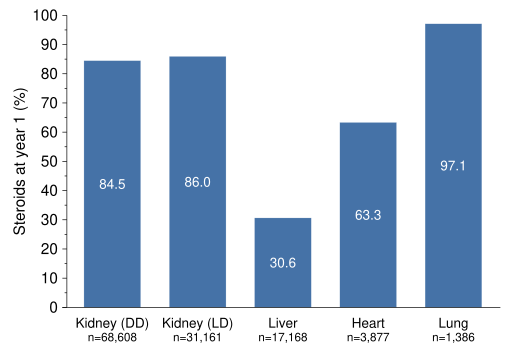
In this newsletter, we extended the analysis to include adult recipients of living donor kidneys, as well as liver, heart, and lung transplants from 2000 to 2022. Our aim was to assess the association of one-year post-transplant steroid therapy with the subsequent development of osteoporosis. Figure 1 illustrates the variation in steroid treatment across different organ transplants. Nearly all lung transplant recipients (97.1%) received steroid therapy, whereas fewer than one-third (30.6%) of liver transplant recipients did. Especially in liver and heart transplants, there are variations with respect to geographic location and year.
Steroid use differed not only in frequency but also in dosage between graft types. Lung transplant recipients received significantly higher doses (mean ± standard deviation: 8.6 ± 4.8 mg/day) compared to recipients of other graft types, whose average daily doses ranged from 6.5 to 6.9 mg/day. For dose-related analyses, methylprednisolone doses were consistently multiplied by a factor of 1.25.
There were substantial differences in the incidence of de novo osteoporosis beyond the first post-transplant year (Figure 2).
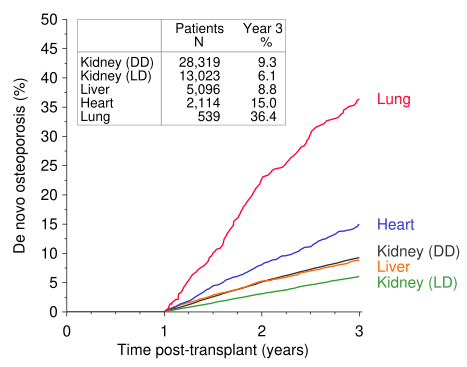
Strikingly, the incidence of osteoporosis was nearly four times higher in lung transplant recipients compared to kidney transplants from deceased donors, and also markedly higher in heart transplant recipients compared to kidney transplants. The lowest incidence of post-transplant osteoporosis in kidney transplants from living donors was likely due to the younger age of the recipients (median: living kidney donor [LD] 40 years; deceased kidney donor [DD] 50 years; liver 53 years; heart 52 years; lung 52 years). In patients aged 60 years and older – particularly relevant for osteoporosis risk – the differences related to donor type in kidney transplantation could not be observed (data not shown).
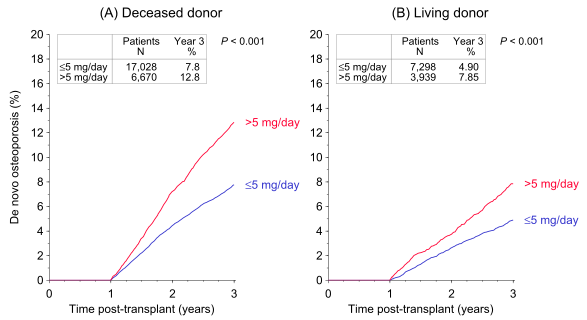
As already highlighted in CTS Newsletter 4:2024, an increased steroid dose (>5 mg prednisone/prednisolone equivalent per day) is associated with a significantly higher incidence of de novo osteoporosis in kidney transplant recipients from deceased donors. Figure 3 shows that, in kidney transplants, both recipient groups (deceased and living donors) exhibited an approximately 1.6 fold higher cumulative incidence of de novo osteoporosis when the steroid dose exceeded 5 mg/day.
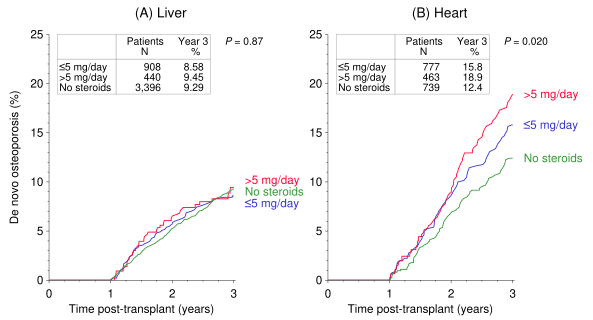
Interestingly, for liver transplant recipients, of whom less than one-third received steroids, no significant association between steroid dosage and de novo osteoporosis could be detected (Figure 4A). In contrast, a significant association with steroid dosage was found in heart transplant recipients, though somewhat weaker than in kidney transplants (a 1.2-fold increase in incidence with >5 mg/day compared to =5 mg/day, Figure 4B).
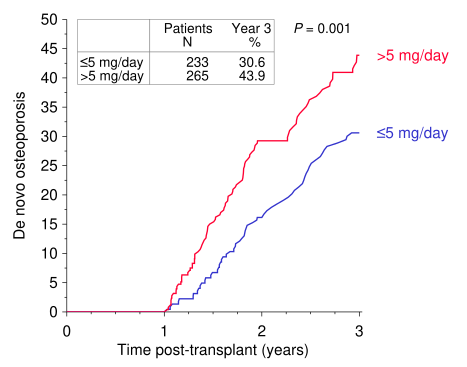
Among lung transplant recipients, who almost all received steroid therapy, a significant association between steroid dose and the incidence of de novo osteoporosis was also evident (Figure 5).
These findings suggest that careful management of steroid therapy is critical, particularly in high-risk groups such as lung and heart transplant recipients, to mitigate the risk of osteoporosis and its associated complications.
Personal notes
Christian Morath, MD, a member of the Executive Board of the CTS, has recently left Heidelberg and is now head of the Department of Nephrology, Nuremberg Hospital, Paracelsus Medical Private University, Nuremberg. We most sincerely thank Christian for his extensive and dedicated work for the CTS and are very glad that he will continue to support our activities. As Christian’s successor, Martin Zeier, MD, head of the Department of Nephrology, Heidelberg University Hospital, Heidelberg, is now member of the Executive Board of the CTS. Martin has been supporting the CTS with great commitment over decades and we are extremely happy and proud that he is now serving on our board.
The next shipping date of
Serum and DNA for the Biomarker Studies is
July 18, 2025.

Hien Tran
| For the CTS Executive Board and CTS Team in Heidelberg | |||
| Axel Roers | Klemens Budde | Martin Zeier | Hien Tran |